
Why do we keep reaching for our phones, crave another swipe on dating apps, or get stuck in cycles of short-lived highs? The answer lies in the brain’s dopamine pathways. These circuits don’t just create pleasure; they teach your brain what to repeat.
Whether it’s scrolling, eating, or chasing connection, that’s how dopamine works: it fuels motivation and locks behaviors into place.
It’s important to understand that the problem is not dopamine itself. It’s that the system reinforces both what helps you grow and what silently drains you, paired with the fact that we live in a socio-cultural age where services, apps and experiences are designed to silently drain you.
The good news is that the same loops that power unhealthy coping, from compulsive texting to chemsex binges, can also be redirected toward focus, resilience, and meaningful goals.
In short — How Dopamine works
- The core idea: Dopamine is not just “pleasure” — it’s a teaching signal that tells your brain “this works, repeat it”.
- Why we get stuck: Quick hits from apps, food, substances and casual connection hijack dopamine loops, reinforcing short-lived highs and long-term dissatisfaction.
- Dark side of the loop: Dating apps, compulsive scrolling, binge behaviors and chemsex cycles all exploit the same reward pathways.
- How change happens: With awareness, substitution, reframing and celebrating progress, dopamine can be redirected toward focus, resilience and meaningful goals.
- Role of Mental Coaching: Science-based Mental Coaching structures this process, helping you break old reward cycles and build new, empowering ones through neuroplasticity.
Table of Contents
How Dopamine Shapes Behavior
Dopamine is not simply the “pleasure chemical.” It is a teaching signal that tells your brain: “this works, do it again.”
Each time you act and experience a reward, it reinforces the circuit that produced it. Over time, the loop becomes automatic; cue, action, reward, with little conscious decision-making.
This is why habits feel natural. The brain tags even small rewards as valuable: a message notification, a bite of sugar, a like on social media. The dopamine spike may fade quickly, but the pathway is strengthened, making you more likely to repeat the behavior.
Importantly, dopamine does not distinguish between helpful and harmful patterns. It powers both the routines that build resilience and the cycles that keep you stuck. This explains why you return to coping strategies they wish to eliminate, even when you know the cost.
The good news: with mental training and guided practice, its pathways can be retrained and thus redirected. Just as they once reinforced distraction or avoidance, they can be rewired to strengthen focus, discipline, and long-term satisfaction.
The Dark Side: Dopamine Loops Gone Wrong
When dopamine circuits are hijacked by quick rewards, the result is a cycle that can grow compulsive. You get the temporary high, the brain tags it as important, and the loop strengthens, even if it leaves you drained or dissatisfied afterward.
Some examples include:
- Dating app frenzy — endless swiping fuels novelty-seeking, but often leaves users more anxious and disconnected, treating connection as if it was a short-lived e-commerce experience.
- Compulsive smartphone use — every notification brings a small dopamine spike, training the brain to crave constant checking; after all for your brain it means “someone is noticing me”, “something beautiful could happen”, “I can’t leave things out of control, let me check it”. Attention, hope, potential, control.
- Binge eating, smoking, drinking, substance use — using food, alcohol, or drugs as relief, which temporarily soothes stress but reinforces dependence to cope with stress (even the smaller ones, trough time).
- Chemsex cycles — combining sex and substances creates powerful chemical floods, followed by emptiness and deeper craving (read more).
These loops don’t happen because you are weak. They happen because the brain is wired to repeat what feels rewarding in the moment, even if the long-term cost is high, and because apps, drugs and substances are invented with this principle in mind, to monetize as much out of the drain the make of you.
Recognizing this mechanism is the first step to taking back control.

Rewiring Dopamine for Growth
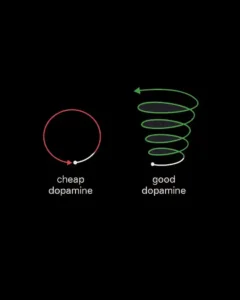
The power of dopamine is not a curse; it is a resource. The same pathways that make distraction addictive can also make progress rewarding. That’s what fuels, as an example, every body builder (and why I frequently work with them) or fitness enthusiast as opposed to all the people trying to avoid physical exercise. The key is to retrain what your brain tags as valuable.
Coaching and mental training use practical tools to redirect neural circuits:
- Awareness — identifying the cues and triggers that set loops in motion.
- Substitution — replacing the old action with a healthier one that still brings a sense of reward.
- Reframing — shifting how the brain interprets discomfort, turning stress into a signal for growth instead of escape.
- Celebrating progress — consciously rewarding small wins to strengthen new circuits through repetition.
This doesn’t mean “switching off” dopamine. It means putting it to work for you, linking motivation to habits that align with your goals instead of draining them. Over time (because neuroplasticity takes time), the circuits of distraction weaken, and the circuits of focus and resilience take over.
Science based Mental Coaching is where this process becomes structured: guiding you step by step as you break old reward cycles and install new, empowering ones.
Scientific Evidence
Research in neuroscience has shown how dopamine circuits shape behavior, for better or worse. Far from being just a “pleasure molecule,” this neurotransmitter is central to motivation and habit formation.
- A review in PubMed Central highlights how it regulates reinforcement learning, driving both healthy habits and compulsive behaviors.
- Studies on habitual behavior published by the APA confirm that repeated dopamine responses explain why unwanted patterns persist, even against conscious intentions.
These findings support the core idea of mental training: the brain repeats what it rewards. By guiding what gets reinforced, coaching helps redirect the same biology that once fueled distraction toward clarity, resilience, and growth.
Quick Definitions
- Dopamine
- A neurotransmitter involved in reward, motivation and learning, signaling to the brain which behaviors are worth repeating.
- Dopamine pathway
- A network of neurons that carries dopamine signals, linking cues, actions and rewards into reinforced behavior loops.
- Dopamine loop
- A repeated cycle of cue → behavior → reward driven by dopamine spikes, which can underlie both healthy habits and compulsive patterns.
- Quick reward
- A fast, short-lived pleasure or relief (like a notification, a swipe, or a drink) that strongly activates dopamine but rarely supports long-term wellbeing.
- Mental Coaching
- A structured, science-based coaching process that uses awareness, substitution and reinforcement to redirect dopamine toward constructive habits and goals.
FAQs
u003cstrongu003eWhat is a dopamine detox and does it work?u003c/strongu003e
A dopamine detox doesn’t literally reset dopamine. What it does is reduce overstimulation from constant quick rewards (social media, junk food), giving your brain space to enjoy more sustainable sources of motivation.
u003cstrongu003eCan you be addicted to dopamine itself?u003c/strongu003e
Not exactly. People aren’t addicted to dopamine but to the activities that trigger dopamine spikes, such as gambling, dating apps, or substance use.
u003cstrongu003eIs dopamine always bad?u003c/strongu003e
Dopamine is never bad! It’s our relationship with the chase of dopamine with no output of anything constructive, that is toxic. Dopamine is essential for learning, motivation, and pleasure. The challenge is that it reinforces both helpful and harmful habits depending on what you repeat.
u003cstrongu003eCan mental coaching change how my brain reacts to rewards?u003c/strongu003e
Yes. By building awareness, reframing cues, and rewarding progress, coaching helps you rewire which actions your brain finds motivating.
u003cstrongu003eWhy do I lose motivation so quickly after starting something new?u003c/strongu003e
Because dopamine surges at the start of novelty. Without reinforcing small wins along the way, motivation fades. Structured practice and coaching keep the circuit engaged long-term.

Comments and Questions
0 Comments